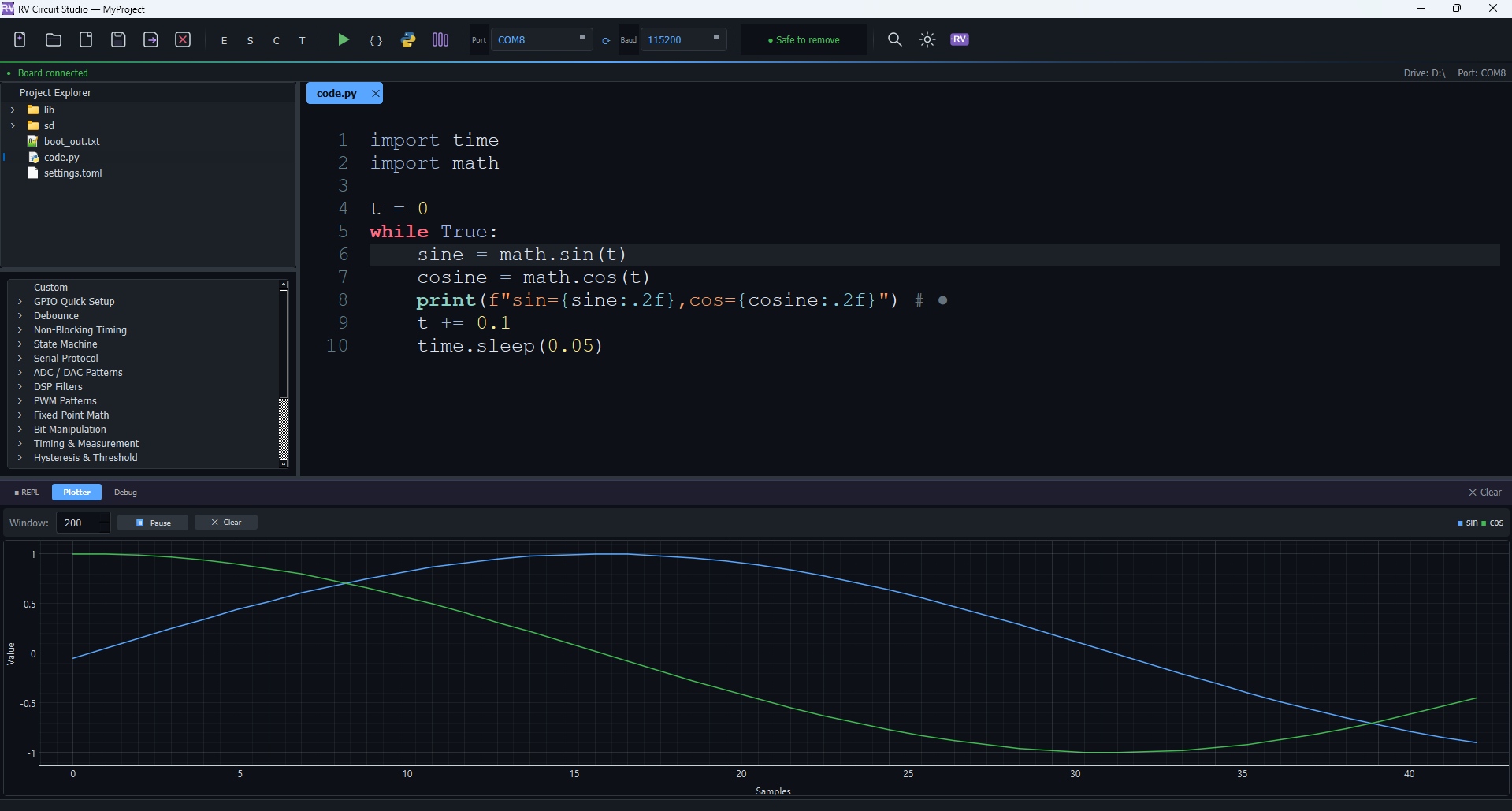
CircuitPython made embedded programming approachable. You plug in a board, it shows up as a USB drive, you edit code.py, and it just runs. No toolchains, no flashing rituals which for a lot of people that's the whole appeal.
But the editor side of that experience has always been the weak link. Mu was the friendly default for years, and it served its purpose, but development has slowed and it leaves a lot on the table for anyone who wants to go past blinking an LED. There are online IDE's but many perons myself included prefer an offline solution. That gap is what RV Circuit Studio is built to fill.
Today I'm releasing v0.1.4.
What it is
RV Circuit Studio is a desktop IDE for CircuitPython, and aims to be a drop in replacement for Mu, but it assumes you want to do real work: debug, watch variables, plot live sensor data, and manage libraries without leaving the editor.
The design philosophy is simple and, I think, increasingly rare: it runs entirely offline. No accounts. No cloud sync. No telemetry. No third-party servers sitting between you and your board. You can run it straight off a flash drive, and your code never leaves your machine. For classrooms with spotty internet, for labs with data-privacy requirements, or for anyone who just doesn't want a development tool phoning home, that matters.
What's in it
The feature set is aimed at the developer who has outgrown a plain text box:
- Editor with syntax highlighting and code folding that auto-detects connected CircuitPython boards. Save, and
code.pyis written to the CIRCUITPY drive and the board reloads on its own, exactly the workflow you already know. - Serial REPL with color support, so the console output is readable instead of a wall of monochrome text.
- A source level debugger with breakpoints and watch expressions. This is the big one that Mu lacked, print statement debugging only takes you so far; being able to stop execution and inspect state changes how you work on anything non trivial.
- A real time serial plotter for visualizing sensor data as it streams in, because if like me you've ever squinted at scrolling numbers trying to picture a waveform, this replaces that.
- A library manager for Adafruit bundles, so pulling in dependencies doesn't mean manually copying files into
lib. - A snippet manager preloaded with common CircuitPython patterns.
Getting it
On Windows, grab the standalone portable .exe from the Releases page. No installation and no admin privileges needed, you can just put it on a flash drive and go. On any platform with Python 3.10 or newer:
pip install rvcircuit-studio
rvcircuit-studio
macOS and Linux are both supported through pip. (On macOS, if the command isn't found after install, you may need to add your Python bin directory to your PATH.)
Hardware support
This release is tested against the Raspberry Pi Pico and Pico 2 but I'd recommend the Pico 2 (because it has a RISC-V core in there) but it should work with any CircuitPython board, since the workflow is built on the standard CIRCUITPY drive convention rather than anything board-specific. Support for the Baochip and Dabao boards is coming soon. That's deliberate, the aim is bringing a clean, offline, privacy-respecting CircuitPython experience to RISC-V silicon is exactly where this project is headed, RISC-V being a first class citizen.
Why this exists
RV Circuit Studio is part of a larger effort to make embedded development on RISC-V hardware genuinely accessible, not just possible for people who already know the toolchains, but approachable for makers, students, and educators. CircuitPython is one of the best on ramps in all of embedded, and it deserves tooling that respects both the beginner's need for simplicity and the working engineer's need for real debugging. There are some really good online IDEs but these ignore the constraints of the developing world and the global south, the Rovari Platform seeks to make RISC-V shippable from anywhere.
The project is open source under Apache 2.0. Bug reports are welcome, you can open an issue for anything significant. I'm not accepting pull requests at the moment given the current flood of AI generated PRs across open source, but I'm very open to suggestions, so reach out by email if you have ideas.
Try it, point it at a Pico 2, and let me know what breaks.
--- Armstrong Subero, rvembedded.com
Repo: github.com/ArmstrongSubero/rvcircuit-studio